
Hurricane Erin and TEAL-SHIPS drifters (September 2025)
We deployed wave drifters courtesy of Martha Schonau and the SIO Lagrangian Drifter Laboratory on the RV Cape Hatteras during TEAL-SHIPS 3. This was particularly interesting as it was in the lead up to Hurricane Erin that was making its way from the tropics to our region. Several references were made in the Storm Center Communications youtube clips covering the storm. The UNCW Research Office also ran a short story on the website.
TEAL-SHIPS in the news (February/March 2025)
The next several years will be exciting for Marine Science at UNCW. We have a collaborative project sampling coastal and Gulf Stream waters funded by the UNC system that will eventually use our new 73′ coastal catamaran. The first voyage for Transect Expedition to Assess Land-to-Sea Habitats via Interdisciplinary Process Studies (TEAL-SHIPS) was in February, 2025. Here is a short clip on local news an article in the Coastal Review and the UNCW press release on TEAL-SHIPS.
ROXSI modeling on ACCESS News (December 2023)
The NSF-sponsored HPC program ACCESS, and its predecessor XSEDE, have been a terrific resource for me in my work. These programs allocate computational cores and storage to researchers at smaller universities without an HPC to complete projects that we would otherwise not be able to. I am thankful for their support and the allocation provided on the University of Delaware cluster, DARWIN. A short article on the ROXSI modeling program was posted here: see link to article
Moana Project conclusion announced (September 2023)
The Moana Project has officially ended. I was honored to work on this project and we have some on-going student presentations and collaborations as part of this interdisciplinary effort. Read the story here
Comment on warm NC ocean water (July 2023)
Marine Heat Waves are increasingly a topic of public concern. This is for good reason as abnormal ocean conditions can have adverse ecosystem consequences. Although the general concept of warm (or cold) anomalies and extreme events are common in our scientific communities, the terminology “Heat wave” and “Cold spell” appear to be more successful in raising public awareness of these occurrences. Current conditions off of the southeast U.S. are receiving some attention. I provided a few comments to the News & Observer, see the article linked here.
Frying Pan shoals project featured on Coastline (March 2023)
Wilmington public radio station WHQR featured an interview with our PIs Joe Long and Fred Scharf to discuss our exciting interdisciplinary project to research Frying Pan Shoals. Check out the Coastline podcast here. Or a short write up is available on Coastal News Today here.

ARMS paper in NOAA Climate Program Office news (September 2022)
Our recent work on exchange throughout the nearshore region has been summarized/reviewed in the NOAA Climate Office newsletter. Check it out here.
St Clair to St Kilda Coastal Plan (August 2020)
The Dunedin City Council has an extensive public engagement campaign around future-planning and management of the wave-exposed St Clair and St Kilda coastal areas (see additional information here). University of Otago MSc student, Connor Davenport, has contributed model rip current experiments towards this effort (see his poster here). Thank you to Tom Simons-Smith, DCC, for his support ofthis work.
Southeast Marine Protected Area (August 2020)
The New Zealand Ministers of Conservation and Primary Industries are planning a network of Marine Protected Areas around the South Island. During the consultation period, I submitted a letter with my perspective on marine connectivity built on interpreting regional physical oceanography and recent “virtual particle tracking” results using Moana Project numerical model output. You can find this letter here:
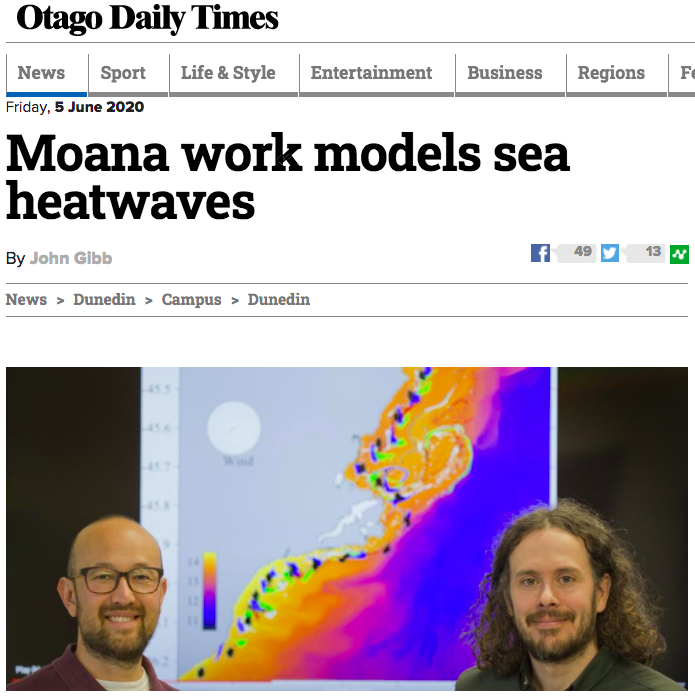
Moana project in the Otago Daily Times (June 2020)
Rob Smith and I had our contribution to the Moana Project highlighted here. See the full animation of this model output posted on Youtube.
 Seasick Suanda